
I Sat Down to Help My Nephew With a 401k Form. Three Hours Later, We Built a Budget From Scratch.
The impromptu personal finance workshop with my nephew in a restaurant.
(Initially published on Medium.com, 18-May-2026)
I thought this would take twenty minutes, tops.
My nephew, ‘Karl’, started a trade job that has benefits. His three-month probationary period is about to complete and he will be eligible to contribute to a 401k.
My brother asked me to speak with my nephew, since my brother doesn’t have a job with benefits.
We met about two weeks ago.
I thought this would be a 20 minute discussion over dinner — you know, a quick 401k form review with a few selections and then on with family chit chat. Nope.
He has a good job, a good paycheck. He’s in a good space, right?
I’d been through this process a few times over my career, so this won’t be a big deal, right? Truth be told, I’ve had a SEP-IRA for last 25 years, so I wasn’t up on the latest 401k limits or options. It was easy enough to figure out.
I explained and recommended the Roth 401k path; it’s the one I wish I had when I started. Those tax-free dollars later in life will be helpful!
Then, the conversation turned towards contributions. His company allows him to contribute up to 75% of his pay — this floored me as I hadn’t seen anything like that 30 years ago, but it started the conversation. His company matches 50% of his contributions up to his 6% — so he’s getting 3% for the 6% or more that he contributes. Good news, that part hadn’t changed since I’d seen a 401k.
Me: Okay, let’s do this. How much do you want to contribute?
Karl: I don’t know. I’m working an average of 55–60 hours per week and here’s my paystub.
Initial thoughts
Hey, Karl is in a pretty good place.
He’s earning extra money per week with no signs of stopping in the near term. He lives at home. He’s frugal. He has a truck payment; he should be in a good place. Let’s figure out if he can do 15% like I used to do. He would really be putting his best foot forward with that approach.
Before that, and hearing his comment about 55–60 hours per week, I shared a story about his uncle who had a similar job 35 years ago. His uncle also worked a lot of overtime (70–80 hours/week) with no end in sight. He bought a brand new Chevy pick-up that had a $800–900/month payment (this was mid-1990’s) that he easily afforded — until he couldn’t. His company cut overtime and his truck got repossessed by the bank. He was living beyond his means.
Key message I told him:
Always budget using your base take-home pay — never assume the overtime is a given; even when it is flowing for months. If you do, you are risking everything. Use the overtime money to pay down debt, do extra things, save extra, but never use it for your baseline budget.
And, we moved on.
Me: Let’s figure out how much you can contribute. What’s your budget? Where do you spend your money? What are your bills?
A Moment of Honest Surprise… for Both of Us
Oh man, where to start on this?
Hi first response was about having about $800 in cash tucked away and he usually keeps $600–800 in his checking account to ensure he can pay his bills. OK, a good start, but that’s not a plan, nor a budget.
Back and forth, we talked through his bills. I knew about his truck loan (~$750/month).
He has two credit cards with balances.
It turns out he had two other loans, that he called ‘tool truck loans’. This was new for me, but it makes sense. We’ve all probably seen these panel trucks on the road from companies like Snap-On Tools. They go to manufacturing facilities and sell tools to the technicians — and expensive tool boxes to house them.
As a new hire, chances are that you don’t have the tools or money to buy them, so they finance them for you.
Of course, they finance and the interest rate is about 14%. He has two of these loans.
His tool box, stocked with initial tool selection, was $12,000 — that’s not a typo. Twelve-thousand dollars. Since then, he’s bought more tools and as I mentioned, he has two loans that total about $600/month in payments. My eyes widened in disbelief; he smiled out of pride how many tools he had. Wow.
The truck visits sites on a regular basis and they are happy to add new tools to your financing — you need them, so they’ll help you out.
After discussing the truck loan and two tool truck loans, he said that was all of his bills.
He honestly believed that was the extent of his commitments. I knew that couldn’t be it.
We kept talking and writing down his monthly bills and came up with his budget.
It went something like this, Me/Karl:
What about truck insurance? / Oh, yeah, that’s $200/month.
What about fuel for your truck? / Oh. Yeah. That’s about $120/month.
What about date night? Don’t you have a girlfriend? / Oh, we are frugal and take turns paying — that’s about $120/month.
Any subscriptions, like Netflix? / Yeah, I pay for two of those. (Huh? Ok, let’s ask later about that.)
Do you pay for lunch at work? / Yeah, that’s probably $60/week.
No mention of incidentals, like clothes, toothpaste, etc. I assume he got some help from his parents; we didn’t get that far. At this point, I thought we at least identified 80–90% of his current expenses.
As we listed things out, I was mentally adding things up and it became clear that he was much closer to spending his take-home pay (with overtime) than I thought.
And that was before we discussed his future. He’s living at home. The future may include buying an engagement ring. His girlfriend is about to graduate from her trade school and wants to get a place of their own.
My Surprise
My nephew was a 26-year old with steady income, no budget, no sense of his cash flow and no overall perspective on his debts or a plan to pay them off.
Worse than that, he’s treading water like his uncle did by relying on his overtime to pay his bills — and he didn’t even know it. I was slightly relieved I shared the uncle story before we started — it set the scene.
No judgment from me, just genuine surprise and a recognition that he was another example of a young adult that never had someone sit down with him to do this.
And, all of this even before he moves out of his parents’ house and considers getting married. At the moment, he can’t afford to move out or get engaged. I told him as much to ensure he recognized this.
I wrote about the importance of young people learning about personal finance in this article. My chat with my nephew validates this perspective.
His Surprise
It was hard to read how he felt; he’s a quiet person, but we talked about it and he acknowledged the data we outlined.
I think he saw the bigger picture and the need to look longer term and outline a plan to get out of debt.
The Debt
Karl recognized he is in a tight spot, but he has room with his overtime pay to dig himself out and pay off debts within two or three years (maybe sooner), depending on how his final expense and budget list shakes out.
His debt interest rates range from 12.5% to upwards of 30% on nearly $57,000 of total debt. Wow.
He has been paying extra on various bills, but with no rhyme or reason. His one credit card is for a local store that has 0% interest and he was keen to pay that off. I explained that’s interest-free debt and let’s focus on the 14% to 30% interest debt first. He didn’t understand the math part as much as I assumed.
I think he has a clearer perspective now, but he has some work to do. Luckily, we were able to identify some specifics of his debt given online banking and his smartphone apps, but there are more details to confirm to develop a real plan for clearing the debt. Quantifying all those details is necessary to have a real budget and basis for a long-term plan.
The Path Forward
Karl and I discussed some key steps he needs to take and we can meet again.
- Do an expense audit — review all credit cards and bank statements to confirm all monthly expense line items and values. He needs to confirm his monthly expenses.
- Collect all debt statements to determine balances, minimum payments, interest rates, remaining duration, etc.
- The sign-up for the 401k happens in two weeks. Find out more details on how they address overtime when calculating company contributions. Attend the information meeting and learn about the options they offer.
- Plan on contributing the 6% to the 401k to not lose the company match, but all other extra cash needs to go to emergency fund and highest interest debt.
- Let me know when he wants to meet to do a follow-up visit as there is more work to do. He’s not done yet.
My action was to summarize our notes and create an initial budget in a spreadsheet. I did it that night when I got home from our visit and emailed it to him. I was also going to outline a multi-year plan to illustrate how he could pay off his debts, but I realized we need clarity on his expenses before creating that — it wouldn’t be accurate yet without confirming those details. The last thing I want is to set an expectation that’s not realistic; he needs the hard facts and address this once to make a solid plan.
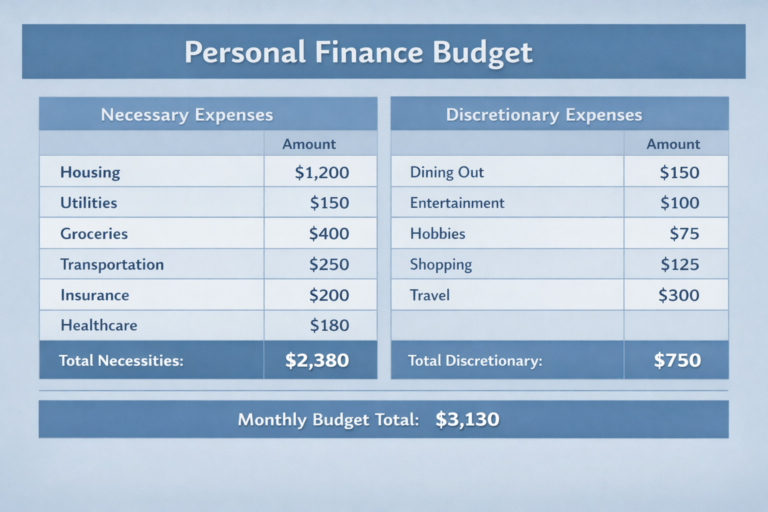
His Draft Budget
He now how a working draft of a personal budget; details to be confirmed and expanded as necessary.
And now that the budget exists, there’s a real conversation to have about the path forward: pay down high-interest debt aggressively, and as each payment disappears, redirect that cash toward retirement contributions.
We discussed how he needed to go ‘sharpen the pencil’ to confirm his expenses & debt terms (balances, interest rates, remaining payments) before we can make a realistic plan.
Parting Ways
As we hugged and said our good-byes, he mentioned off the cuff,
“Yeah, I also need to start working to pay off my student loans. I owe about $10,000 from when I was in college five years ago, but I don’t have to pay anything on them right now. But, that’s not a problem because I have $7,000 saved up and hidden at home to pay that off.”
Me: (eyes wider and jaw on floor)
WHAT!? How could you not mention that as we talked through your bills and the whole point was to make a plan to help you? And, by the way, $7,000 will not payoff a $10,000 balance!” UGH! “Confirm the details of the loan and let’s get it in your budget when we meet or chat again.”
I don’t know what else to say about that. I’m still shaking my head, not in judgment but disbelief. It’s another example on how some folks don’t know their full budget, debt and net worth.
Takeaways
What I keep coming back to: the 401k form discussion took ten minutes. The conversation around it took three hours. And those three hours (the budget, the debt reality check, the overtime dependency he didn’t know he had ) will matter more to his financial life over the next thirty years than any single contribution percentage we put on that form.
Nobody taught him this. Nobody sat down with him and asked. That is not a character flaw. It is a gap, and gaps can be closed.
If you have a Karl in your life, consider asking the follow-up questions. You might be surprised what you find and what a difference it makes to simply show up and do the math together.
We covered a lot of materials in our three hour visit. I was concerned it may have confused him more than helped, so I followed up with texts to my nephew after the visit to recap.
Hi Karl, I hope it didn’t get lost in our discussion last night, but the reason for asking about your budget, expenses and income was all about determining how much you could afford to put in your 401k and have a plan. Your 401k contributions are essentially a budget expense line item so figuring out how much is possible means figuring out your whole budget. Also, FYI, when you put 6% in, it will either be $120 (6% of your base hours) or more if they include your overtime in the 6% calculation. But either way, 6% is the minimum to contribute and then work around that for the rest of the budget. I didn’t flush out the multi-year spend profile to show how quickly you can pay off your debt; the first thing is to confirm the full details before taking that step.
His reply:
Ok I’ll look at it and thank you for talking to me about it last night. I really appreciate it
Then me:
You’re very welcome. I’m glad to help as much as you want or need. Getting finances sorted out is one of those important life skills that they don’t teach enough of in high school (or college). Please reach out when you’re ready to chat more. I don’t want to pester you so you let me know. We can arrange as many chats or meetings as you want.
He said thanks. And I’m hoping and waiting he reaches out again.
Last week, I did hear from my brother that my nephew told his sister’s fiance that his sister (my niece) should also reach out to have a similar discussion with me because it really helped him. That’s quite a compliment and I hope she does.
Two weeks later, no updates yet from my nephew or calls from his sister, but I’m here when they want to talk. I can’t force them to take my advice or even discuss their financials. I think there is a bit of ignorance and denial, so deferring the discussions of real numbers is an implicit tactic they don’t know they are using.
I’m here when they are ready.
Enjoy Life and Thanks for Reading,
-Jeff