

Tips to Inspire Contributing to Your Retirement Savings
Two initial financial goals for your retirement savings. Plant & nurture your own money tree until it becomes self-sustaining!
(Initial publication on Medium.com, 10-Feb-2025)
Are you a ‘20-something’ or ‘30-something’ and wondering if it’s worth contributing to your retirement savings?
Maybe you haven’t even considered the question?
Why should you?
You’re young. You have bills and other priorities. You have time to think about it later, right?…
My response:
Yes! It is worth contributing to your retirement savings from an early age. If you can afford to put even a little money aside, you’ll be grateful later as you watch your savings grow — ultimately at a rate faster than your contributions.
This article outlines two initial financial goals to set for yourself and key benefits and reasons to do it.
Note: This article is based on retirement accounts available in the USA. If you’re in another country, some info may not be relevant for you.
Have you heard the Chinese Proverb, “The best time to plant a tree is 20 years ago. The second best time is now”?
Have you planted your money tree?
Not yet? Well, plant it now!
Here are two financial goals to help your money tree grow.
I’m sharing these two as the bare minimum you should do.
Of course, the more you can contribute to your retirement savings early on, the better your chances of accumulating sufficient money to provide the retirement lifestyle you want.
Goal #1: Contribute (at least) the minimum funds to receive the full company-matching contributions
Many US companies provide matching retirement fund contributions that match the employee’s contributions up to a limit.
From my experience, the company-match funds were typically 50% of employees’ contributions up to a maximum company contribution of 3% of your salary.
So, if an employee contributed 6% of their salary, the company matched 50% of the 6% and contributed 3%. That’s 9% into your retirement account.
That is a fantastic return on investment.
Doing this each year is fundamental to building your retirement savings.
Note: You can’t go back and fund previous years if you previously elected to not contribute, so grab that instant 50% return on investment every year. It’s free money. And by the way, it’s part of what your employer considers your total compensation package — they budgeted for it — you need to claim it.
Each year’s contributions help your retirement savings (i.e., your money tree) grow.
When you’re just starting your career, perhaps your contributions will be fairly small amounts. That’s okay. By saving, you will start a lifelong savings habit that will serve you well as you continue saving over your career.
And you started your own money tree.
Depending on your salary, it will take a few years before you see a notable balance in your retirement funds, but you will eventually see a balance, and annual returns will mark a key milestone – that’s Goal #2.
Goal #2: Consistent contributions to reach the equivalent of a ‘self-funding’ retirement account.
As you continue to contribute each year, getting the company-matching funds and hopefully contributing more than that minimum, you will watch your balance grow each year.
You will eventually notice that the annual return of your account balance exceeds the annual contributions you’re making.
When you reach that milestone, theoretically you could stop contributing to your retirement funds, and (assuming similar market returns) your retirement account will keep growing at the level you were contributing or even more.
That is a great feeling.
There’s a level of financial security to know that your retirement savings are growing on their own similar to what you were contributing.
An older friend pointed out this milestone when he reached it.
It made an impact on me. I was only a few years out of university, so I was just starting my savings — they were hardly notable amounts which can be frustrating when you want it to grow.
Goal #2 became a milestone target for me and helped me stay focused on my retirement savings.
It takes time — be patient and stay the course.
Reference the simple example below, using:
- Base salary of $75,000 (USD) with a 2% annual raise.
- 6% employee contribution and 3% company-matching contribution.
- 7% annual growth from investments (I used a conservative figure to illustrate the point; long-term average market returns are higher).
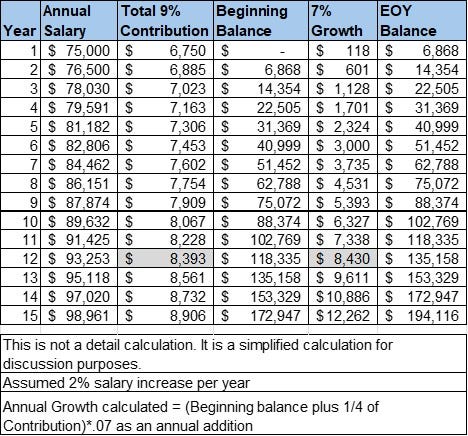
From the table, you can see that in year 12, the annual growth exceeds the annual contribution.
Congratulations! That’s a great milestone! Your money tree will continue to grow on its own at a rate exceeding your contributions!
But, don’t use it as an excuse to take the foot off the gas — keep contributing as much as you can!
You will likely reach this milestone sooner than the 12 years in my simplified calculations; I didn’t want to show data that look like a get-rich-quick story.
In reality, market returns can be higher.
You’ll receive larger salary increases. The compounding return will be calculated monthly instead of annually.
The chart below illustrates the lost growth if you stop contributing after year 12.
Yes, your money tree grows without additional contributions, but look at the lost opportunity to double your savings if you continue to contribute.
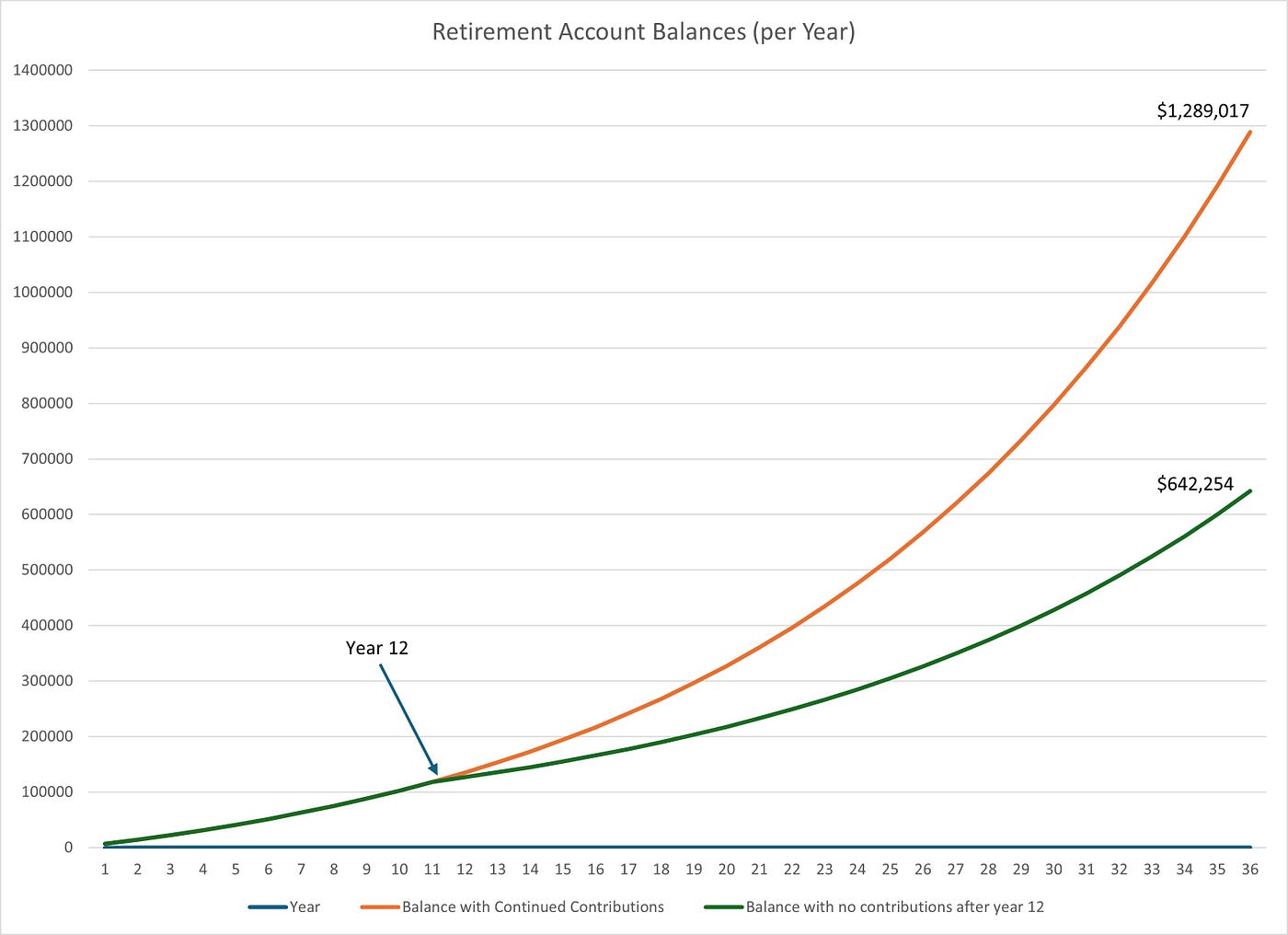
Ideally, when you reach Goal #2 milestone, you established good money savings habits and will continue to contribute.
After the Goal #2 milestone is reached, set your next target.
Perhaps your next milestone is when your annual growth is twice your contributions? More?
For each of these milestones, you will see how your account balance grows significantly each year and so does your financial security.
It’s a marathon, not a sprint for sure.
Takeaways
- This article is about encouraging you to start saving for your retirement and sharing some minimum goals or steps to get started and setting some initial goals.
- GOAL #1: Contributing the minimum contribution to your retirement account that gets your Company-matching contribution really must be your minimum contribution. Many companies match 50 cents on the dollar up to 6% of your contributions. That 3% company match is an immediate 50% return on your investment. Why decline this benefit?
- GOAL #2: Continue contributing and investing your funds until your annual investment returns meet or exceed your annual contributions. Reaching this milestone effectively means that your investment returns are now funding the growth of your retirement plan.
- Develop savings habits that promote lifelong savings — both in retirement accounts and taxable accounts.
- Even if you stop contributing, your fund will continue to grow like you are still contributing (assuming similar annual investment returns). But, please don’t stop contributing.
- It’s a great feeling to see your assets continuing to grow at or above the contributions you previously made when you open up that quarterly or annual financial statement. You planted the money tree and now it’s growing on it own.
- If you are questioning the benefits of continuing to contribute, don’t forget you are earning 50% return with the company match. That’s free money they want to give you, so take it!
- Max out the contributions as you are able. You can’t go back to contribute for previous years — this is a benefit you must claim each year to make use of it.
- Make use of ROTH retirement plans (401k or IRA) if you can. That compounds the benefits for the longer term.
I hope your financial situation permits you to contribute at least the minimum amount to your retirement account and that you can continue to save until you reach the sweet spot where it could be considered self-funding as outlined above.
If you question your ability to make a contribution, remember you’re giving up free money if your company matches any portion.
If your circumstances permit it, I encourage you to max out your savings from the very start of your career as I was coached to do and shared in this article last year.
Hopefully, you can continue contributing the max throughout your career and your money tree grows large and strong to support you in your retirement years.
These two goals should be the minimum initial steps to help you develop long-term savings and savings habits that will create a financial nest egg for your future.
And, one more tip, if you switch jobs, don’t use that as an excuse to cash out the retirement funds you accumulated. There will likely be taxes and penalties – and you will have chopped down your money tree requiring you to start over. Keep it growing!
Enjoy Life and Thanks for Reading,
-Jeff
Disclaimer
This article is intended for informational purposes only, and should not be considered financial, investment, business, tax, or legal advice. You should consult a relevant professional before making any major decisions.